

Supreme Court Ruling Final
The Supreme Court ruled that IEEPA does not authorize tariffs. If your business imported goods since February 2025, you may have a claim for every dollar of IEEPA duty you paid, plus annual interest owed to you.

The government will not issue these refunds on its own. Importers who take action now will be in the strongest position when refunds are processed.
If you are the importer of record and you paid IEEPA tariffs since February 2025, there is likely money recoverable for your business. It does not matter if you are a manufacturer, wholesaler, retailer, distributor, or e-commerce seller.
The right to pursue recovery belongs to the importer of record, the entity that paid the duties to CBP, even if you passed the cost on to your customers.
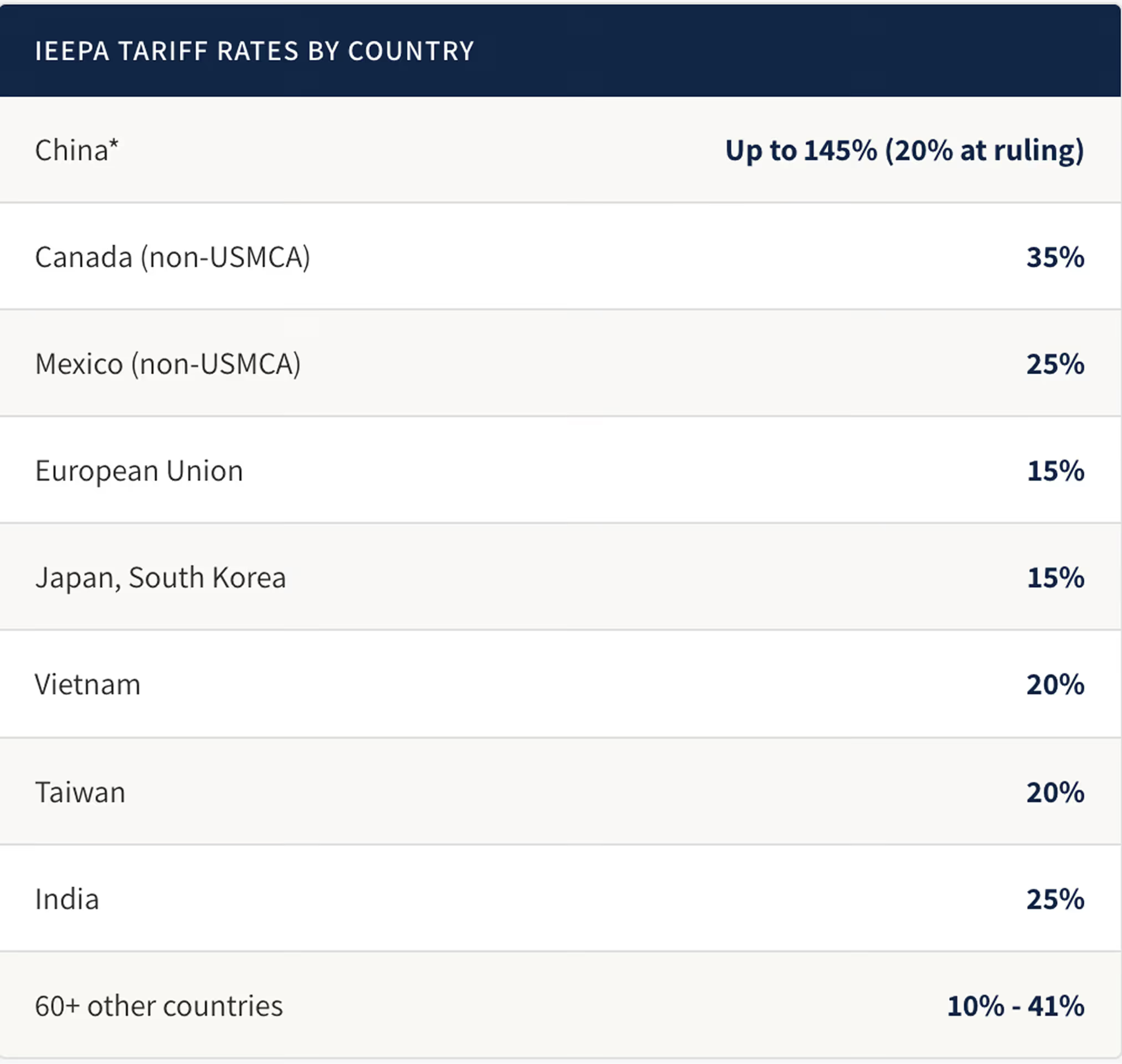
These tariffs cover imports from China, Canada, Mexico, the EU, Japan, South Korea, Vietnam, Taiwan, India, Brazil, and 50+ additional countries.
*China IEEPA rates changed multiple times during the collection period (from 10% to as high as 145%), and ranged from 20% to 30% for most of the period. The 20% shown reflects the combined rate at the time of the Supreme Court ruling. Your actual recovery may be substantially higher depending on when your goods entered.
Rates shown reflect final IEEPA rates as of February 2026. Actual rates varied during the collection period. Recovery calculations require entry-level analysis.
Timing Matters
The ruling is final. What it did not do is return the money. The deadlines are real and approaching fast.

The Administration has indicated they will not voluntarily return the duties collected. Filing through the Court of International Trade is the most reliable path to recovery.

CBP finalizes import entries roughly 314 days after entry. The first 180-day protest deadlines on liquidated entries arrive around June 2026. Missing those windows narrows your options.

In January 2026, the DOJ stipulated that it would not oppose refunds for importers who filed protective suits at the CIT, extending coverage to future filers. However, since the Supreme Court ruling, the government has moved to delay the refund process, reinforcing why legal action now is critical to preserving your position.

Filing in the CIT is the safest way to preserve your right to recovery. Importers who wait risk procedural forfeiture if deadlines pass or the refund mechanism narrows. Acting now keeps every option on the table.
Free assessment. No obligation. No fee unless we recover.

We handle every phase of the tariff refund process so you can focus on running your business.

We pull and analyze your import data from the Automated Commercial Environment to identify every IEEPA-affected entry and quantify your total recovery, including principal duties and accrued statutory interest.

We track the liquidation status of all affected entries on a rolling basis, ensuring no filing window closes before you have taken the steps needed to preserve your rights.

Our trade attorneys prepare and file administrative protests with U.S. Customs and Border Protection for unliquidated entries, preserving your right to judicial review under 19 U.S.C. § 1514.
When necessary, we initiate or join a summons and complaint action at the U.S. Court of International Trade to preserve jurisdiction and prevent procedural forfeiture while the court determines the refund mechanism.

We represent your interests in remanded proceedings at the CIT, advocating for streamlined refund processes and defending against government attempts to offset your refund against newly imposed liabilities.

Our CPAs and tax attorneys can advise on the income tax implications of your refund recovery, helping you plan for the tax treatment of returned duties and interest so there are no surprises.
Frost Law AZ is led by Glen Frost, Esq., CPA, a dual-licensed attorney and certified public accountant with decades of experience in tax controversy and financial recovery for businesses nationwide.
Our attorneys are admitted to the U.S. Court of International Trade, the court with exclusive jurisdiction over customs duty disputes. That means we file directly where your case needs to be heard.
We do not charge anything upfront. Our fee is a percentage of what we actually recover. No recovery, no fee.


CPA & Tax Attorney Planning
Our CPAs and tax attorneys can advise on the income tax ramifications of your tariff refund, so you understand the full financial picture before and after recovery.
Trade Lawyers & Customs Brokers
We file protests, monitor liquidation deadlines, pursue CIT litigation, and advocate for the most favorable refund mechanism — every proactive step, taken.
No. The Supreme Court ruled the tariffs were unauthorized, but that does not trigger automatic refunds. The Administration has publicly stated it will not voluntarily return the duties. Recovery requires filing through the Court of International Trade.
Yes. The reciprocal tariffs under Executive Order 14257 cover imports from 60+ countries at rates from 10% to 41%, including the EU, Japan, South Korea, Vietnam, Taiwan, India, and Brazil. The ruling covers all IEEPA tariffs.
There is a two-year statute of limitations for CIT filing. China tariff deadlines arrive around February 2027, with Canada, Mexico, and reciprocal tariffs following shortly. Liquidated entries also carry separate 180-day protest windows, the first of which arrive around June 2026.
Not as a standalone strategy. The Court of International Trade ruled that IEEPA tariff collection is a "ministerial" action, meaning CBP protests alone are likely insufficient. We recommend combining protests on liquidated entries with CIT to protect your procedural rights and provide the strongest legal protection.
Under customs law, the right to recover belongs to the importer of record, the entity that paid the duties to CBP.
Potentially. Recovered duties and interest may have income tax implications depending on how the original tariff payments were treated. Our CPAs and tax attorneys advise on the full financial picture so there are no surprises when your refund arrives.
Nothing upfront. Our fee is a percentage of what we actually recover for you. If the process does not result in a recovery, you owe us nothing. There is no cost to find out what options are available.
The ruling is final. The only question is whether you take steps to pursue what is recoverable.